
- Services
Company Services
- Mobile
AppDevelopment - Web
Development - Ecommerce
Solutions - AI,
ML&Automation - Cloud
Technologies - Blockchain
Development - Salesforce
Solutions - Game
Development
Don't Hesitate to Collaborate with Us
Contact usAlways Here to Support You
Let's Talk Let's Talk







- Mobile
Working Hours : Monday - Friday, 09.30am - 09.30pm

Posted Date
February 17, 2026
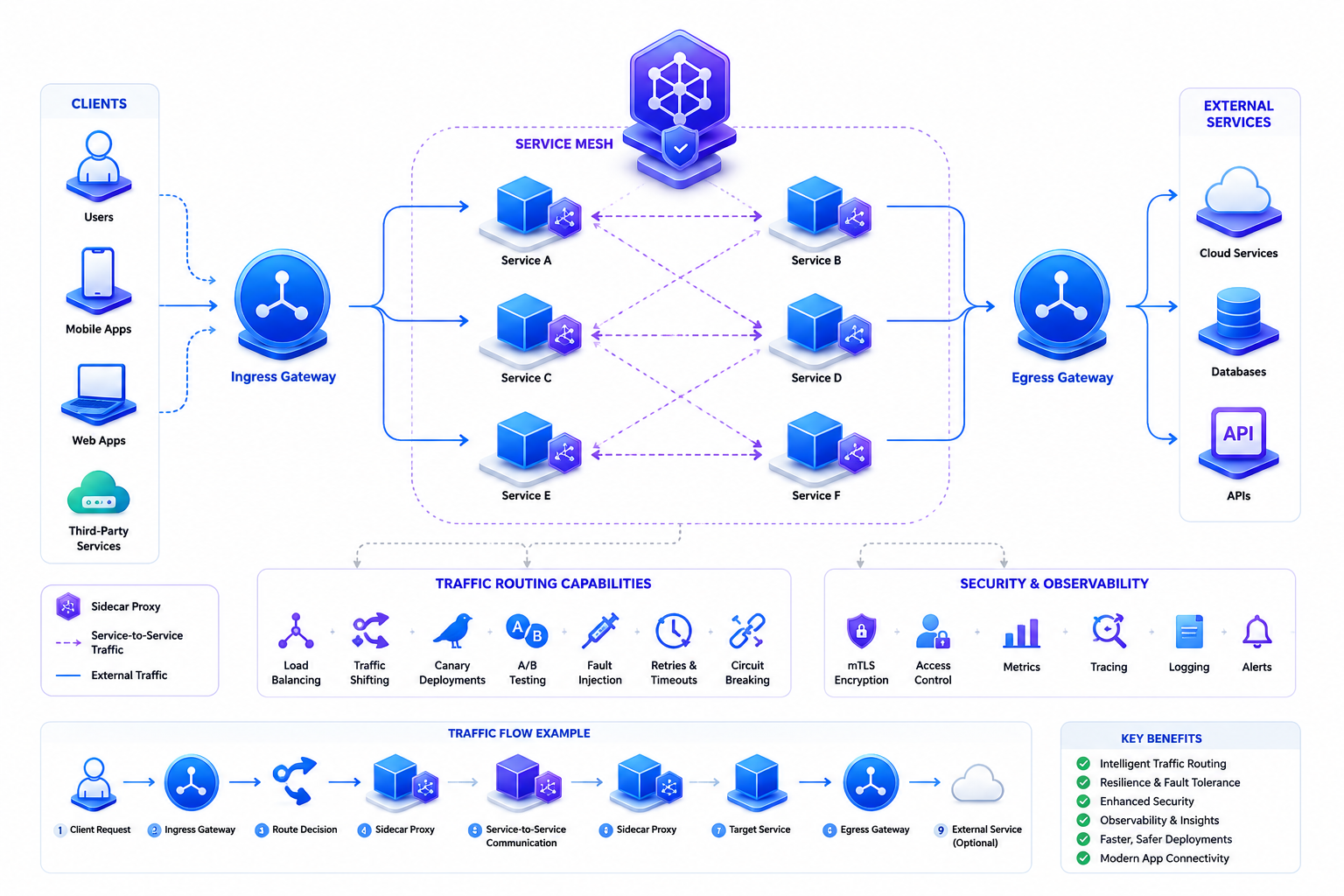
Service Mesh And Traffic Routing For Modern Apps
As organizations adopt microservices and cloud-native architectures, managing communication between services becomes increasingly complex. Service mesh technology provides a dedicated infrastructure layer that handles service-to-service communication, traffic routing, security, and observability without requiring application-level changes. By simplifying operational challenges, service meshes help teams build more scalable, secure, and resilient modern applications.
Why Service Mesh Matters for Modern Applications
Microservices architectures often consist of dozens or hundreds of services communicating across distributed environments.
Managing security, service discovery, load balancing, and traffic routing manually can quickly become complex and difficult to maintain.
A service mesh centralizes these responsibilities, allowing developers to focus on application functionality rather than networking concerns.
Organizations use service meshes to improve consistency, scalability, and operational efficiency across cloud-native environments.
By separating networking logic from application code, teams gain greater flexibility and control.
Key Capabilities of Service Mesh Technology
Traffic management enables intelligent routing, load balancing, and deployment strategies such as canary releases and blue-green deployments.
Security features provide mutual TLS encryption, identity management, and secure service-to-service communication.
Observability tools offer detailed insights into traffic patterns, latency, errors, and service dependencies.
Resilience mechanisms such as circuit breakers, retries, and failover capabilities help prevent cascading failures.
These capabilities allow organizations to build reliable and secure distributed systems at scale.
Implementing Service Mesh Successfully
Organizations should begin by identifying critical services that can benefit most from improved traffic control and observability.
Choosing the right service mesh platform depends on infrastructure requirements, scalability goals, and operational maturity.
Monitoring and governance practices should be established to ensure consistent performance and security across services.
Automation helps teams manage policies, deployments, and configurations efficiently in dynamic environments.
By adopting a service mesh strategy, businesses can improve application reliability, enhance security, and support the growing demands of modern cloud-native architectures.
Case in Point
- Improve service-to-service communication
- Enhance application security and reliability
- 40% faster traffic management and routing
- 30% improvement in application observability
- Enable secure microservices communication
- Reduce operational complexity across services
- Strengthen fault tolerance and resilience
- Accelerate cloud-native application scalability




0%