
- Services
Company Services
- Mobile
AppDevelopment - Web
Development - Ecommerce
Solutions - AI,
ML&Automation - Cloud
Technologies - Blockchain
Development - Salesforce
Solutions - Game
Development
Don't Hesitate to Collaborate with Us
Contact usAlways Here to Support You
Let's Talk Let's Talk







- Mobile
Working Hours : Monday - Friday, 09.30am - 09.30pm

Posted Date
May 29, 2026
Serverless Architecture for Legacy Applications
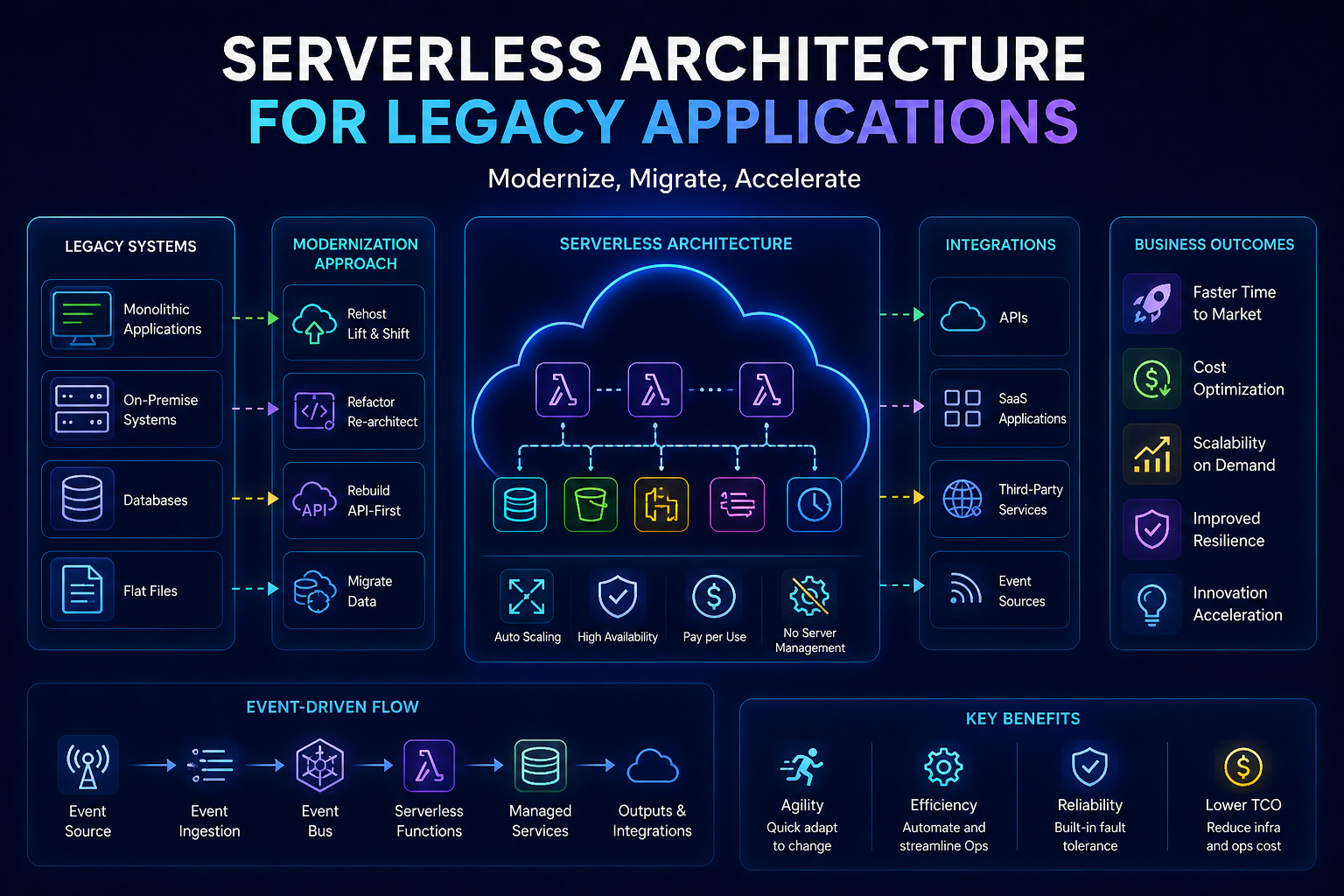
Many organizations continue to rely on legacy applications that are difficult to scale, maintain, and modernize. Serverless architecture offers a practical approach to transforming these systems without requiring a complete rebuild. By leveraging cloud-managed services and event-driven computing, businesses can reduce infrastructure complexity, improve agility, and accelerate innovation while extending the value of their existing applications.
Why Serverless for Legacy Applications
Legacy applications often rely on fixed infrastructure that requires continuous maintenance, monitoring, and scaling management.
Serverless architecture eliminates much of this operational burden by allowing cloud providers to manage servers, infrastructure, and resource allocation.
Organizations can focus on application functionality and business value instead of infrastructure administration.
This approach enables faster development cycles while improving scalability and system performance.
Serverless computing provides a cost-effective pathway for modernizing existing software investments.
Key Components of Serverless Architecture
A typical serverless solution includes API gateways, event-driven functions, managed databases, storage services, and messaging systems.
API gateways securely expose application functionality while routing requests to appropriate backend services.
Serverless functions execute business logic only when triggered, reducing idle resource consumption.
Managed cloud services provide scalability, reliability, and security without requiring extensive infrastructure management.
Together, these components create a flexible and highly scalable application architecture.
Business Benefits of Serverless Modernization
Organizations adopting serverless architectures can significantly reduce infrastructure costs by paying only for resources consumed.
Automatic scaling ensures applications handle varying workloads efficiently without manual intervention.
Faster deployment cycles enable businesses to respond quickly to market opportunities and customer demands.
Operational efficiency improves as development teams spend less time managing infrastructure and more time delivering value.
Serverless modernization helps businesses extend the lifespan of legacy applications while supporting long-term digital transformation goals.
Case in Point
- Reduce infrastructure management overhead
- Improve application scalability and flexibility
- 40% faster deployment and feature delivery
- 30% reduction in operational costs
- Enhance system reliability and availability
- Accelerate legacy application modernization
- Optimize cloud resource utilization
- Support digital transformation initiatives




0%