
- Services
Company Services
- Mobile
AppDevelopment - Web
Development - Ecommerce
Solutions - AI,
ML&Automation - Cloud
Technologies - Blockchain
Development - Salesforce
Solutions - Game
Development
Don't Hesitate to Collaborate with Us
Contact usAlways Here to Support You
Let's Talk Let's Talk







- Mobile
Working Hours : Monday - Friday, 09.30am - 09.30pm

Posted Date
January 7, 2026
Role Of AI/ML In Digital Transformation
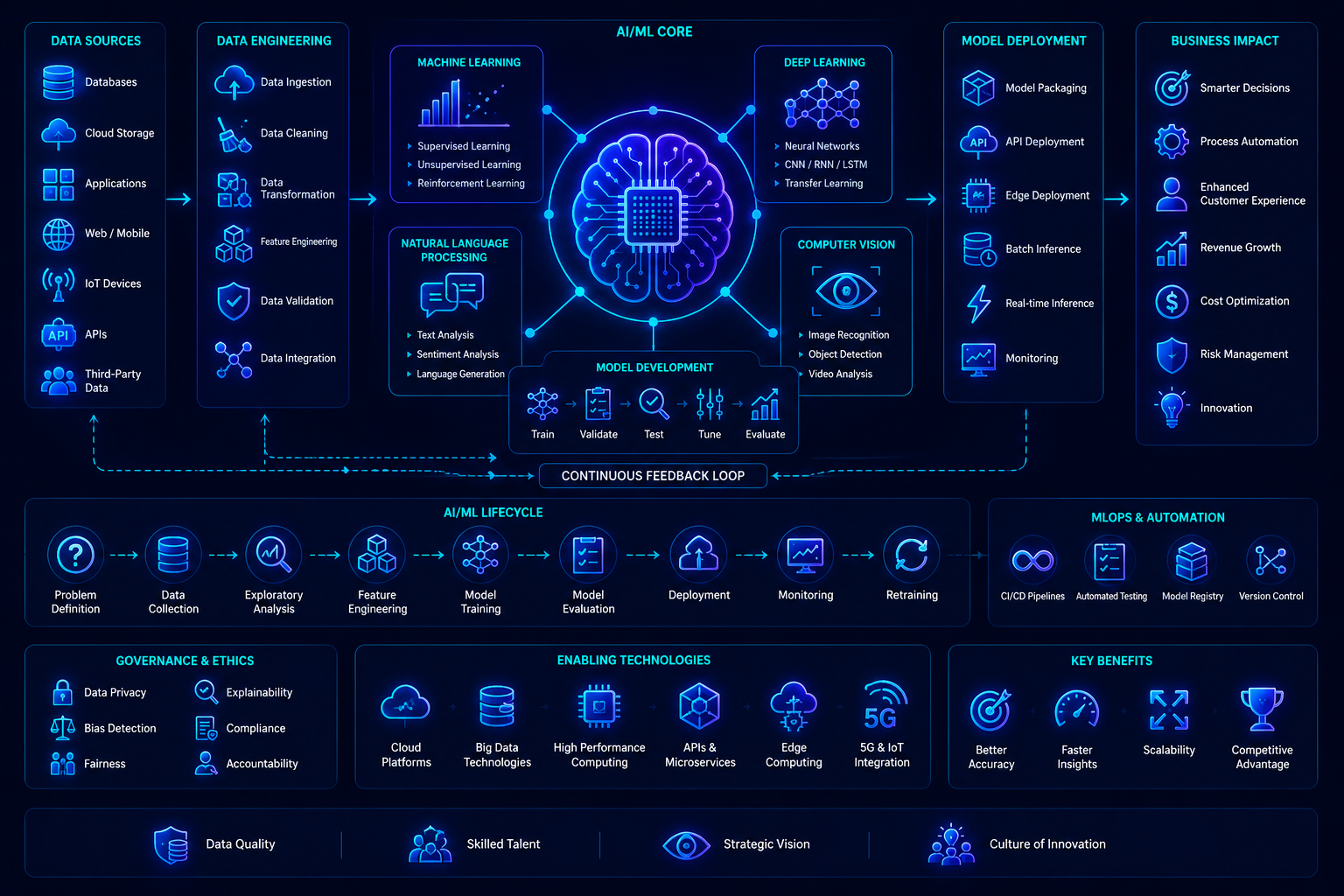
Digital transformation is no longer just about digitizing processes—it is about making businesses smarter, faster, and more adaptive. Artificial Intelligence (AI) and Machine Learning (ML) play a pivotal role in this evolution by enabling organizations to automate operations, gain actionable insights from data, and deliver highly personalized customer experiences. As businesses embrace intelligent technologies, AI/ML is becoming a key driver of innovation, efficiency, and sustainable growth.
Why AI/ML Matters in Digital Transformation
Artificial Intelligence and Machine Learning enable organizations to move beyond traditional automation by introducing intelligence into business processes.
These technologies help businesses analyze large volumes of data, identify patterns, and generate insights that support strategic decision-making.
AI-driven systems can continuously learn and improve, making operations more efficient and adaptable over time.
Organizations use AI/ML to optimize workflows, improve customer experiences, and uncover new growth opportunities.
As digital transformation accelerates, AI becomes a foundational technology for modern enterprises.
Key Applications of AI and Machine Learning
AI-powered chatbots and virtual assistants improve customer service by providing instant support and personalized interactions.
Machine Learning algorithms help businesses forecast demand, optimize inventory, and predict customer behavior.
Predictive analytics enables organizations to identify trends, reduce risks, and make proactive business decisions.
AI-driven automation streamlines repetitive tasks, reducing manual effort and improving operational efficiency.
Across industries, AI and ML are transforming processes, products, and customer experiences.
Building a Successful AI/ML Transformation Strategy
Successful AI adoption begins with identifying business challenges where intelligent technologies can deliver measurable value.
Organizations must establish strong data foundations, including data quality, governance, and security practices.
Cross-functional collaboration between business leaders, technology teams, and data experts is essential for success.
Continuous monitoring and optimization ensure AI models remain accurate, reliable, and aligned with business goals.
By integrating AI and ML into digital transformation strategies, businesses can drive innovation, improve efficiency, and create sustainable competitive advantages in an increasingly digital world.
Case in Point
- Improve business process automation
- Enhance data-driven decision making
- 40% faster operational workflows
- 30% increase in productivity and efficiency
- Deliver personalized customer experiences
- Reduce manual effort and operational costs
- Enable predictive analytics and forecasting
- Accelerate digital transformation initiatives




0%