
- Services
Company Services
- Mobile
AppDevelopment - Web
Development - Ecommerce
Solutions - AI,
ML&Automation - Cloud
Technologies - Blockchain
Development - Salesforce
Solutions - Game
Development
Don't Hesitate to Collaborate with Us
Contact usAlways Here to Support You
Let's Talk Let's Talk







- Mobile
Working Hours : Monday - Friday, 09.30am - 09.30pm

Posted Date
June 9, 2026
Event-Driven Architecture in Modern Systems
Modern digital applications must process large volumes of data, events, and user interactions in real time. Event-Driven Architecture (EDA) provides a flexible and scalable approach where system components communicate through events instead of direct dependencies. By enabling asynchronous processing and decoupled services, EDA helps organizations build responsive, resilient, and highly scalable applications that can adapt quickly to changing business requirements.
What is Event-Driven Architecture?
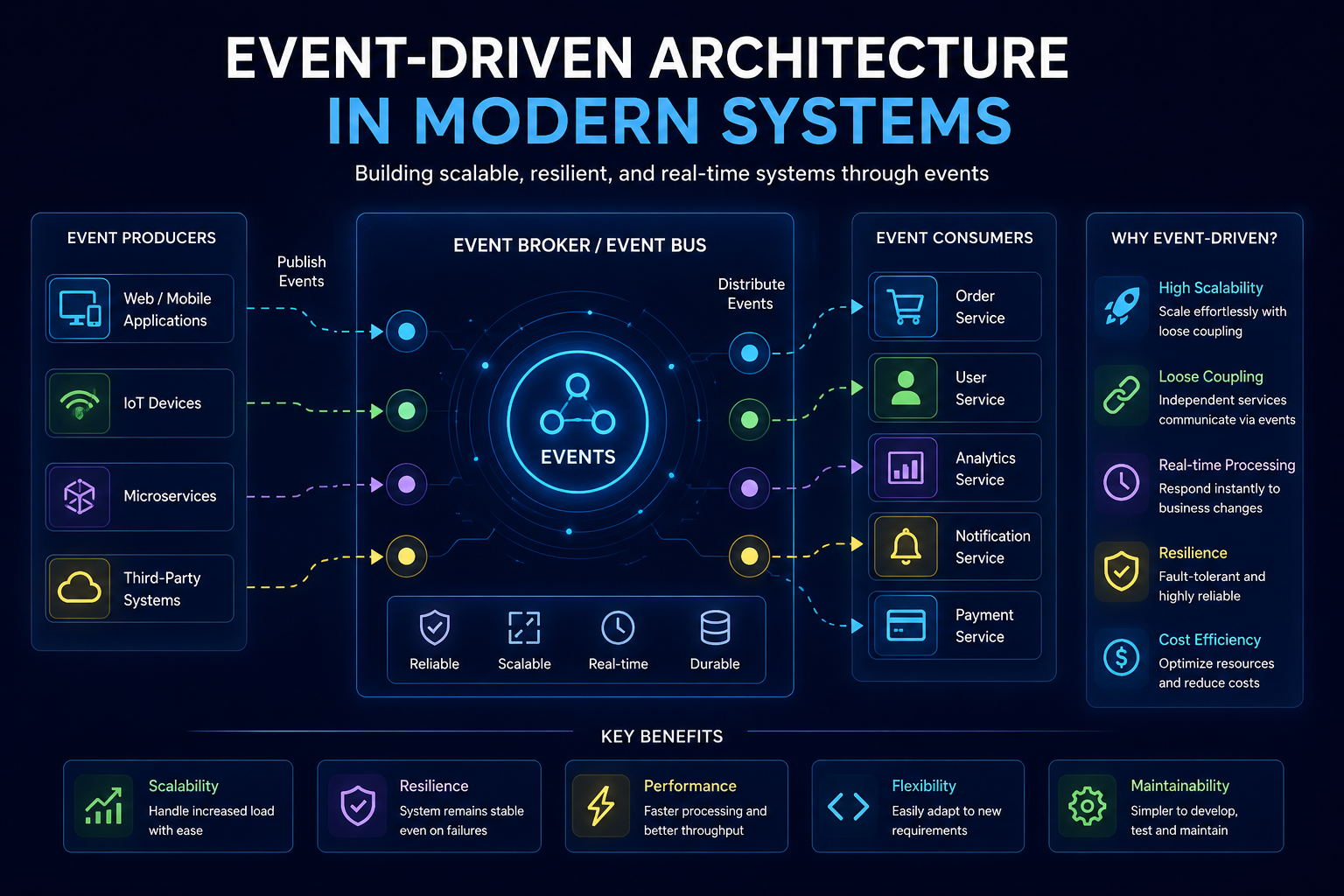
Event-Driven Architecture is a software design pattern where system components communicate through events generated by user actions, system changes, or business processes.
Instead of relying on direct service-to-service communication, applications publish and consume events through messaging platforms.
This decoupled approach improves flexibility, scalability, and fault tolerance across distributed environments.
Events can trigger automated workflows, notifications, integrations, and business processes in real time.
EDA has become a foundational architecture pattern for modern cloud-native applications.
Core Components of Event-Driven Systems
Event producers generate events whenever specific actions or business activities occur within an application.
Event brokers, such as message queues and streaming platforms, manage the delivery of events between services.
Event consumers process incoming events and execute the required business logic independently.
This architecture enables services to scale separately based on workload requirements and event volumes.
By separating producers and consumers, organizations achieve greater system flexibility and operational efficiency.
Business Benefits of Event-Driven Architecture
Organizations using Event-Driven Architecture can process large volumes of transactions and interactions with minimal latency.
Real-time communication improves customer experiences by enabling instant updates, notifications, and automated responses.
Scalable event processing supports business growth without requiring major architectural changes.
Fault isolation and asynchronous communication improve system reliability and reduce the impact of service failures.
EDA empowers businesses to build agile, data-driven applications that support innovation and long-term digital transformation initiatives.
Case in Point
- Enable real-time data processing and responsiveness
- Improve scalability across distributed systems
- 45% faster event processing performance
- Reduce system dependencies and bottlenecks
- Enhance application reliability and resilience
- Support seamless service integration
- Improve operational flexibility and agility
- Accelerate cloud-native application development



0%