
- Services
Company Services
- Mobile
AppDevelopment - Web
Development - Ecommerce
Solutions - AI,
ML&Automation - Cloud
Technologies - Blockchain
Development - Salesforce
Solutions - Game
Development
Don't Hesitate to Collaborate with Us
Contact usAlways Here to Support You
Let's Talk Let's Talk







- Mobile
Working Hours : Monday - Friday, 09.30am - 09.30pm

Posted Date
April 15, 2025
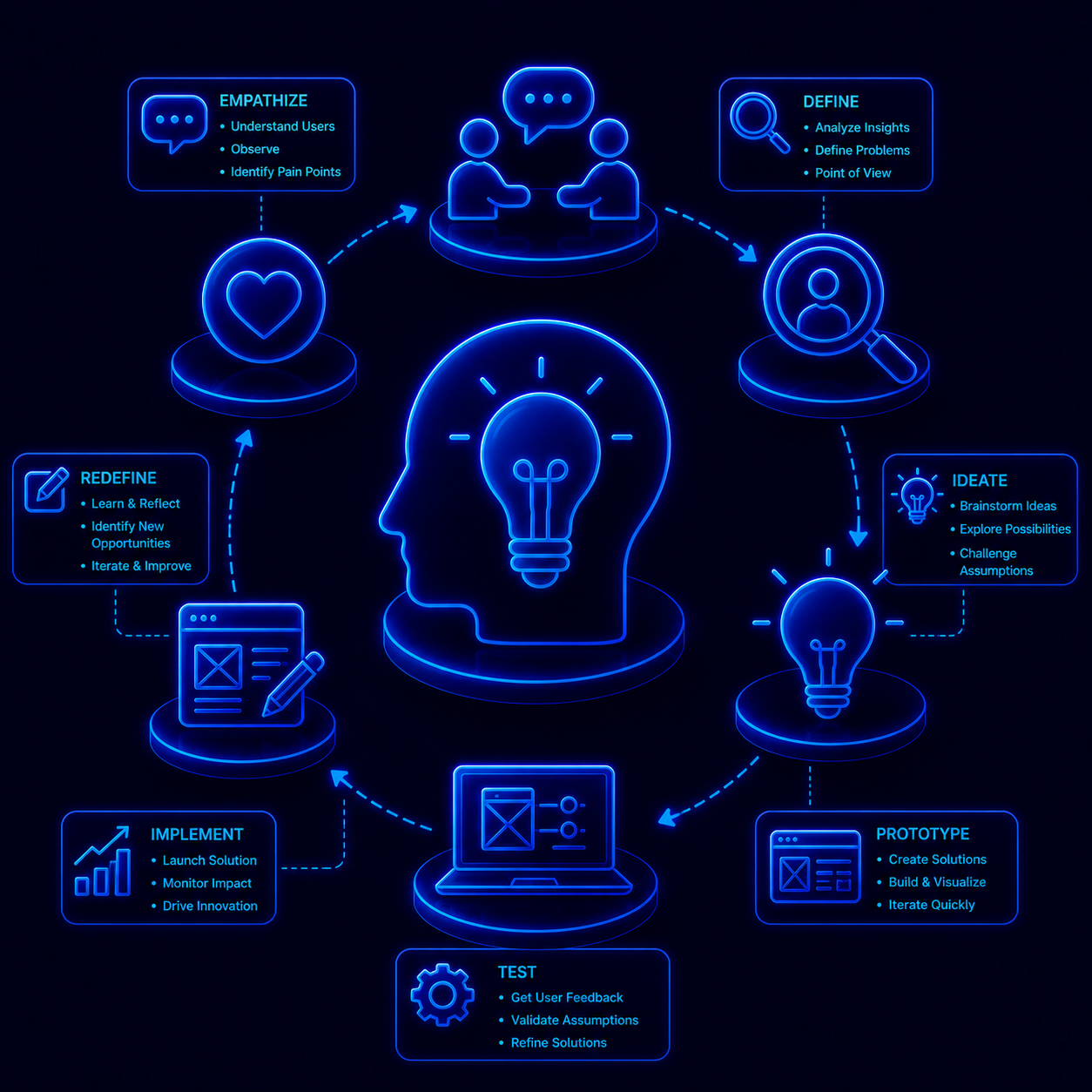
Design Thinking For Product Innovation
Innovation is most successful when it starts with a deep understanding of user needs. Design Thinking is a human-centered approach to problem-solving that helps teams create products, services, and experiences that deliver meaningful value. By combining empathy, creativity, experimentation, and collaboration, organizations can uncover new opportunities, solve complex challenges, and develop innovative solutions that resonate with customers.
What Is Design Thinking?
Design Thinking is a problem-solving framework that prioritizes human needs when creating products and services.
The methodology encourages teams to understand users deeply, challenge assumptions, and explore innovative solutions.
Rather than focusing solely on technical requirements, Design Thinking emphasizes empathy, creativity, and experimentation.
It helps organizations address complex challenges by viewing problems from the perspective of the people they serve.
This approach is widely used across industries to improve products, services, processes, and customer experiences.
The Five Stages of Design Thinking
The Design Thinking process typically consists of five key stages that guide teams from problem discovery to solution validation.
Empathize focuses on understanding user behaviors, motivations, challenges, and expectations through research and observation.
Define involves clearly identifying the core problem that needs to be solved based on gathered insights.
Ideate encourages teams to generate a wide range of creative solutions without limitations or early judgment.
Prototype and Test allow teams to transform ideas into tangible concepts, gather feedback, and refine solutions through iterative learning.
Benefits of Design Thinking in Product Innovation
Design Thinking helps organizations create products that are more aligned with customer needs and market demands.
By validating ideas early through prototypes and testing, teams can reduce development risks and avoid costly mistakes.
The collaborative nature of Design Thinking encourages communication between design, engineering, marketing, and business teams.
Continuous feedback and iteration lead to better decision-making and stronger product outcomes.
Organizations that embrace Design Thinking foster a culture of innovation, adaptability, and customer-centric growth, enabling them to stay competitive in rapidly evolving markets.
Case in Point
- Create products focused on real user needs
- Encourage innovation through creative thinking
- Improve customer experiences and satisfaction
- Reduce product development risks
- Accelerate idea validation and testing
- Enhance collaboration across teams
- Identify opportunities for meaningful innovation
- Support user-centered product development




0%