
- Services
Company Services
- Mobile
AppDevelopment - Web
Development - Ecommerce
Solutions - AI,
ML&Automation - Cloud
Technologies - Blockchain
Development - Salesforce
Solutions - Game
Development
Don't Hesitate to Collaborate with Us
Contact usAlways Here to Support You
Let's Talk Let's Talk







- Mobile
Working Hours : Monday - Friday, 09.30am - 09.30pm

Posted Date
May 12, 2026
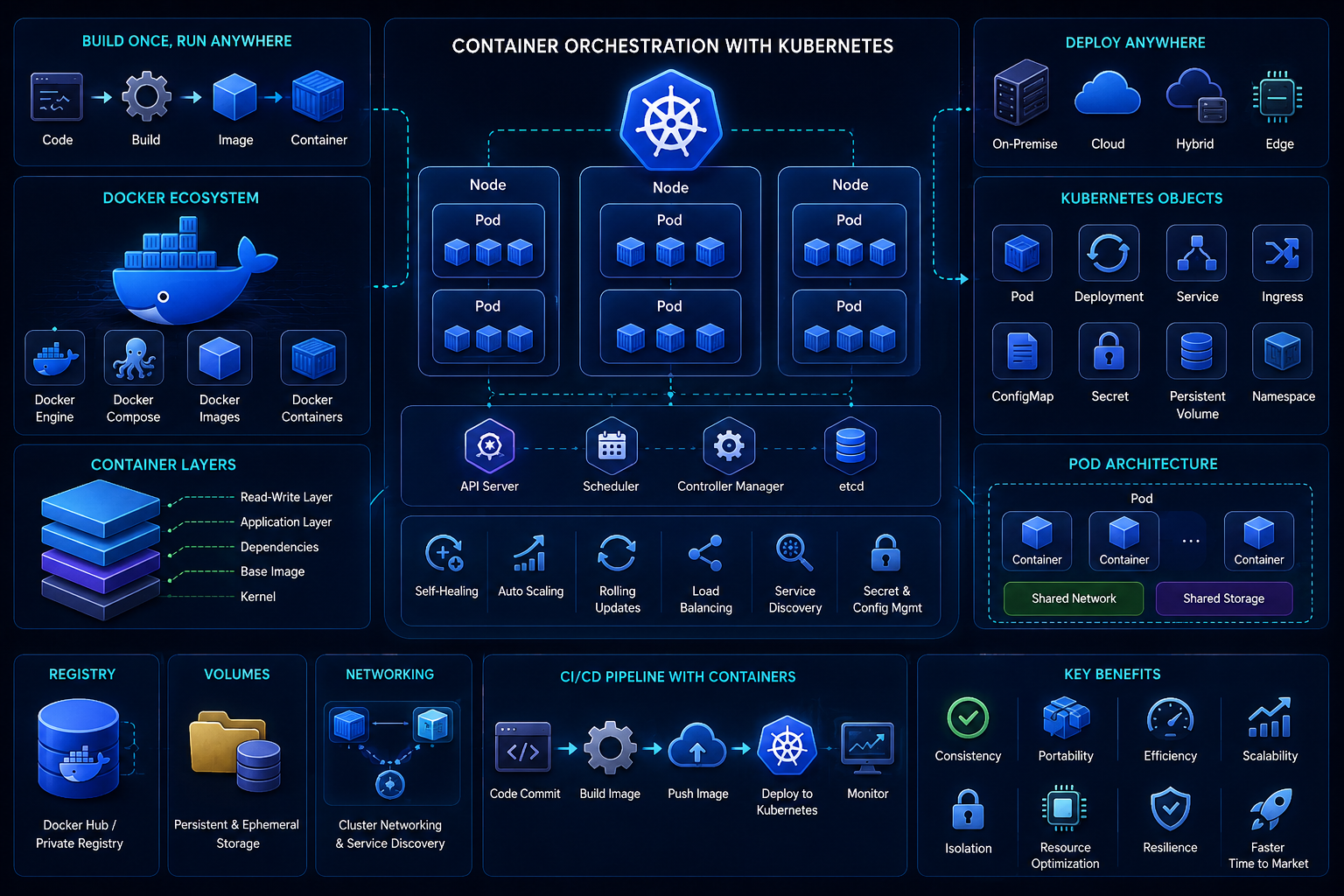
Containerization with Docker and Kubernetes
Containerization has transformed modern software development by providing a consistent and efficient way to package, deploy, and manage applications across different environments. Docker simplifies application packaging, while Kubernetes automates deployment, scaling, and orchestration. Together, they form the foundation of cloud-native application development, helping organizations accelerate releases, improve reliability, and optimize infrastructure utilization.
Why Containerization Matters
Containerization allows applications and their dependencies to be packaged into lightweight, portable units called containers.
Unlike traditional virtual machines, containers share the host operating system while maintaining application isolation and consistency.
This approach eliminates environment-related issues and ensures applications run reliably across development, testing, and production environments.
Organizations use containers to accelerate software delivery while improving scalability and operational efficiency.
Containerization has become a critical component of modern cloud-native architectures.
Docker and Kubernetes Explained
Docker enables developers to create, package, and distribute applications as standardized container images.
These images contain everything required to run an application, including code, libraries, and runtime dependencies.
Kubernetes complements Docker by managing container deployment, orchestration, scaling, networking, and self-healing capabilities.
It automatically distributes workloads across infrastructure resources and ensures high application availability.
Together, Docker and Kubernetes provide a powerful platform for managing modern distributed applications.
Business Benefits of Container Orchestration
Organizations adopting Docker and Kubernetes experience faster deployment cycles and improved development productivity.
Automated scaling helps applications handle fluctuating workloads without manual intervention.
Resource optimization reduces infrastructure costs while maintaining application performance and reliability.
Integrated monitoring, automation, and self-healing capabilities minimize downtime and improve operational resilience.
By leveraging containerization technologies, businesses can accelerate digital transformation and build scalable, future-ready software platforms.
Case in Point
- Improve application portability across environments
- Automate container deployment and scaling
- 40% faster software release cycles
- 30% reduction in infrastructure management effort
- Enhance application availability and reliability
- Optimize resource utilization and performance
- Support cloud-native architecture adoption
- Accelerate DevOps and CI/CD implementation




0%