
- Services
Company Services
- Mobile
AppDevelopment - Web
Development - Ecommerce
Solutions - AI,
ML&Automation - Cloud
Technologies - Blockchain
Development - Salesforce
Solutions - Game
Development
Don't Hesitate to Collaborate with Us
Contact usAlways Here to Support You
Let's Talk Let's Talk







- Mobile
Working Hours : Monday - Friday, 09.30am - 09.30pm

Posted Date
November 4, 2025
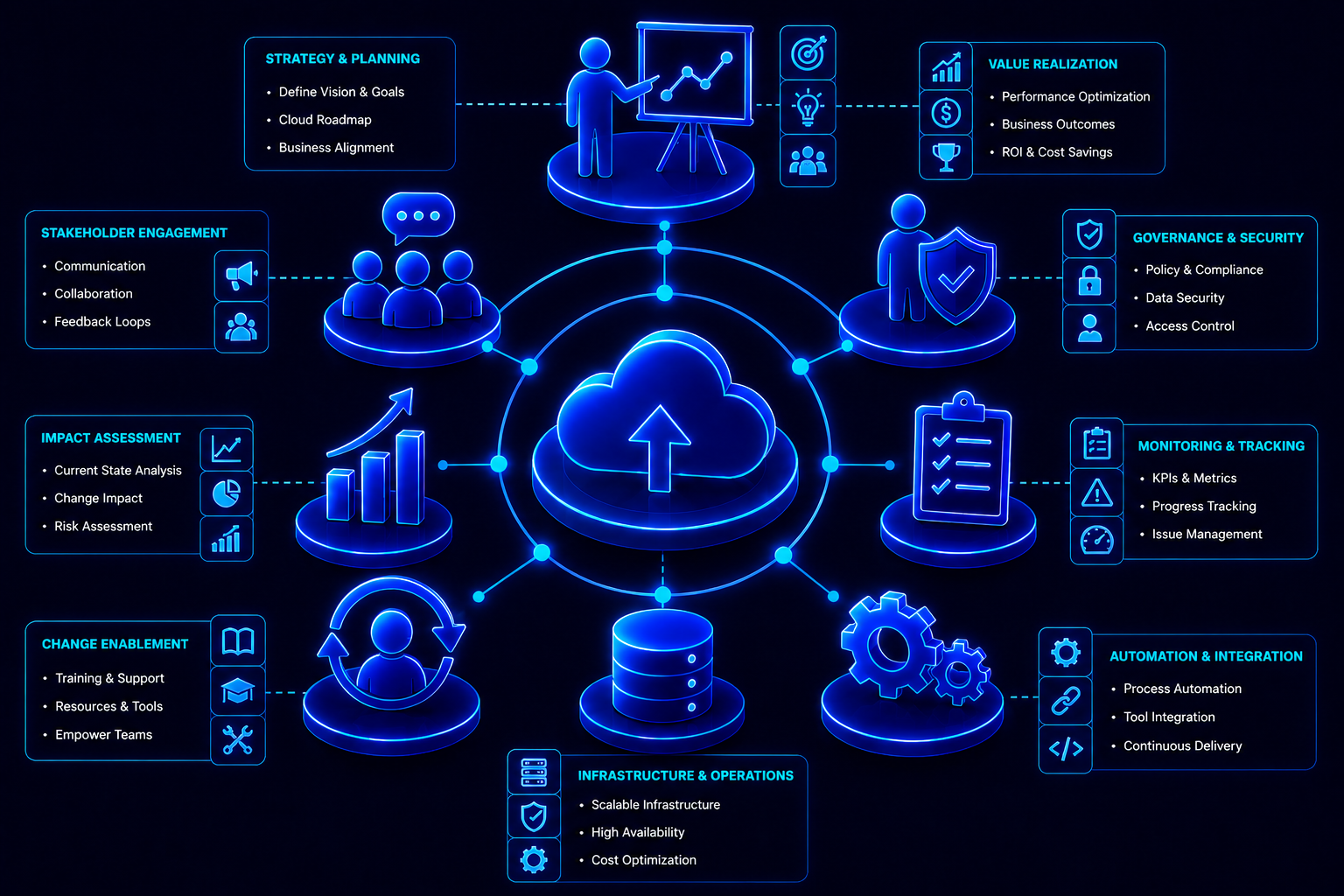
Cloud Strategy For Digital Enterprises
Cloud computing has become a foundational technology for modern enterprises seeking greater agility, scalability, and innovation. However, successful cloud adoption requires more than migrating applications to the cloud. A comprehensive cloud strategy helps organizations align technology investments with business objectives, optimize costs, strengthen security, and create a flexible foundation for future growth. Enterprises that approach cloud transformation strategically can unlock significant competitive advantages in today's digital economy.
What Is a Cloud Strategy?
A cloud strategy is a structured plan that defines how an organization adopts, manages, and optimizes cloud technologies to achieve business objectives.
It outlines the processes, technologies, governance models, and operational practices required for successful cloud adoption.
A strong cloud strategy helps organizations make informed decisions about infrastructure, applications, data management, and security.
Rather than focusing solely on technology, cloud strategy aligns cloud investments with overall business priorities.
Organizations that develop clear cloud roadmaps are better positioned to scale efficiently and respond to market changes.
Key Pillars of a Successful Cloud Strategy
Scalability enables enterprises to adjust resources dynamically based on business demands and workload requirements.
Security and compliance frameworks help protect sensitive information while meeting regulatory obligations.
Cost optimization strategies ensure cloud resources are utilized efficiently and provide measurable business value.
Automation and cloud-native technologies improve operational efficiency, reliability, and deployment speed.
Data analytics and modern cloud services support innovation, business intelligence, and informed decision-making.
Benefits of Cloud Strategy for Digital Enterprises
A well-executed cloud strategy provides organizations with greater agility and the ability to launch new products and services faster.
Cloud platforms improve collaboration, accessibility, and operational resilience across distributed teams and locations.
Enterprises can leverage advanced technologies such as artificial intelligence, machine learning, and big data analytics more effectively.
Strategic cloud adoption reduces infrastructure complexity while enhancing system performance and reliability.
By aligning cloud initiatives with long-term business goals, organizations can drive innovation, improve customer experiences, and achieve sustainable growth in an increasingly digital world.
Case in Point
- Improve cloud scalability and flexibility
- Strengthen security and compliance
- 30% faster application deployment
- 25% reduction in infrastructure costs
- Enhance business continuity
- Support data-driven decision making
- Improve operational efficiency
- Accelerate digital transformation




0%