
- Services
Company Services
- Mobile
AppDevelopment - Web
Development - Ecommerce
Solutions - AI,
ML&Automation - Cloud
Technologies - Blockchain
Development - Salesforce
Solutions - Game
Development
Don't Hesitate to Collaborate with Us
Contact usAlways Here to Support You
Let's Talk Let's Talk







- Mobile
Working Hours : Monday - Friday, 09.30am - 09.30pm

Posted Date
April 16, 2026
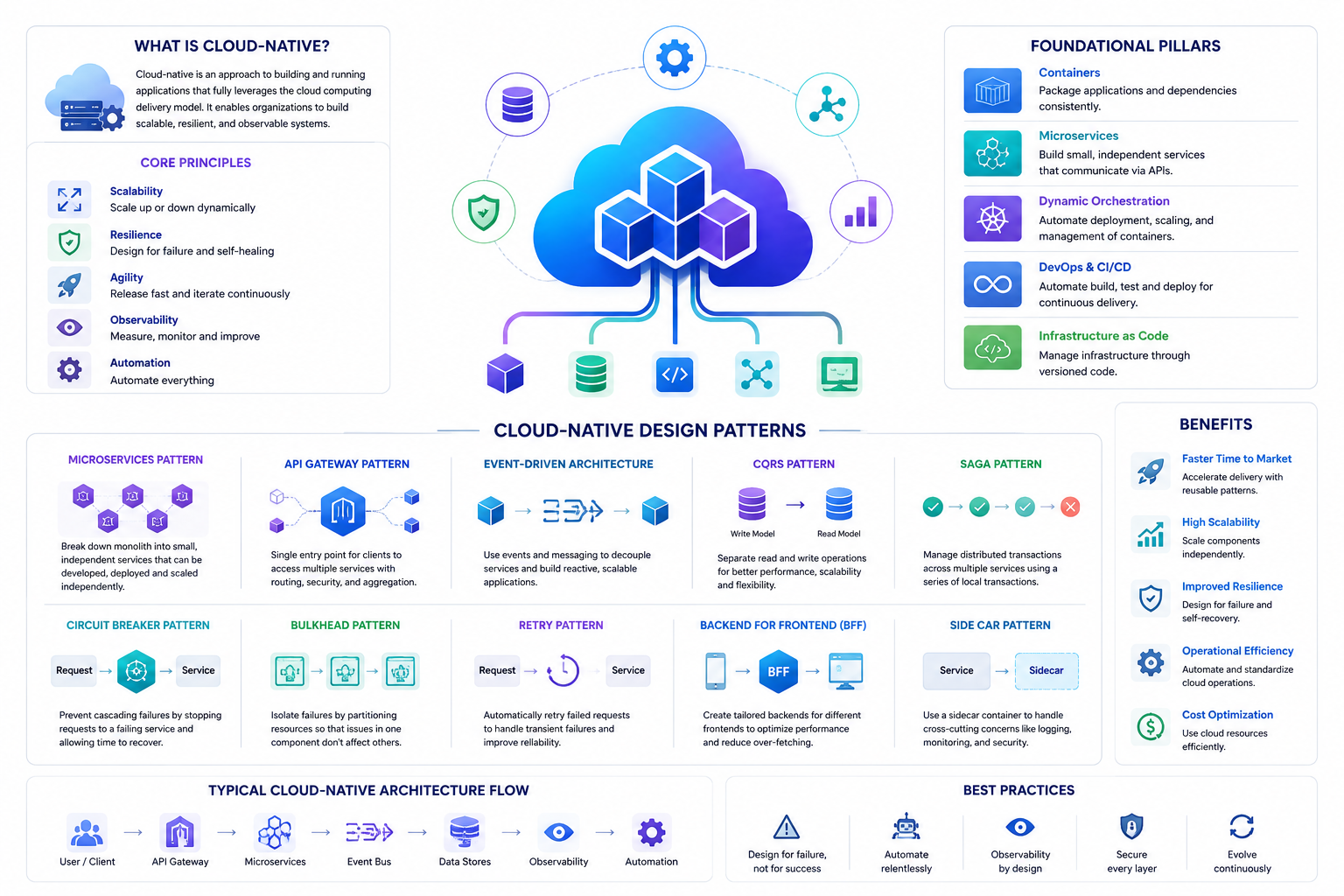
Cloud-Native Design Patterns
Cloud-native applications are designed to fully leverage the flexibility, scalability, and resilience of cloud computing platforms. As businesses increasingly adopt microservices, containers, and distributed architectures, cloud-native design patterns provide proven solutions for building reliable and efficient systems. These patterns help organizations improve performance, enhance fault tolerance, and accelerate innovation while maintaining operational excellence.
What Are Cloud-Native Design Patterns?
Cloud-native design patterns are architectural approaches specifically created for applications running in distributed cloud environments.
These patterns help developers address common challenges such as scalability, reliability, service communication, and fault tolerance.
Unlike traditional monolithic systems, cloud-native architectures focus on flexibility, modularity, and independent service deployment.
Organizations use these patterns to improve performance while supporting rapid development and continuous delivery.
By adopting cloud-native principles, businesses can build applications that adapt quickly to changing demands.
Essential Cloud-Native Architecture Patterns
Microservices architecture divides applications into independent services that can be developed, deployed, and scaled separately.
Event-driven architecture enables services to communicate through events, improving responsiveness and reducing system dependencies.
Circuit breaker patterns prevent failures from spreading across services and improve overall system resilience.
Sidecar patterns extend application functionality by adding supporting services such as monitoring, security, and logging.
These architectural patterns help organizations build highly available and maintainable cloud-native applications.
Best Practices for Cloud-Native Success
Organizations should prioritize automation for deployment, monitoring, scaling, and infrastructure management.
Observability practices, including logging, tracing, and metrics collection, help teams maintain visibility across distributed systems.
Security should be integrated into every layer of the architecture through identity management, encryption, and policy enforcement.
Continuous testing and monitoring ensure applications remain reliable as systems grow in complexity.
By implementing cloud-native design patterns effectively, businesses can create scalable, resilient, and future-ready applications that support long-term digital growth and innovation.
Case in Point
- Improve application scalability and resilience
- Enhance system reliability and fault tolerance
- 40% faster cloud application deployment
- 30% reduction in infrastructure management overhead
- Enable efficient microservices communication
- Support high availability and disaster recovery
- Optimize resource utilization and performance
- Accelerate cloud-native transformation initiatives




0%